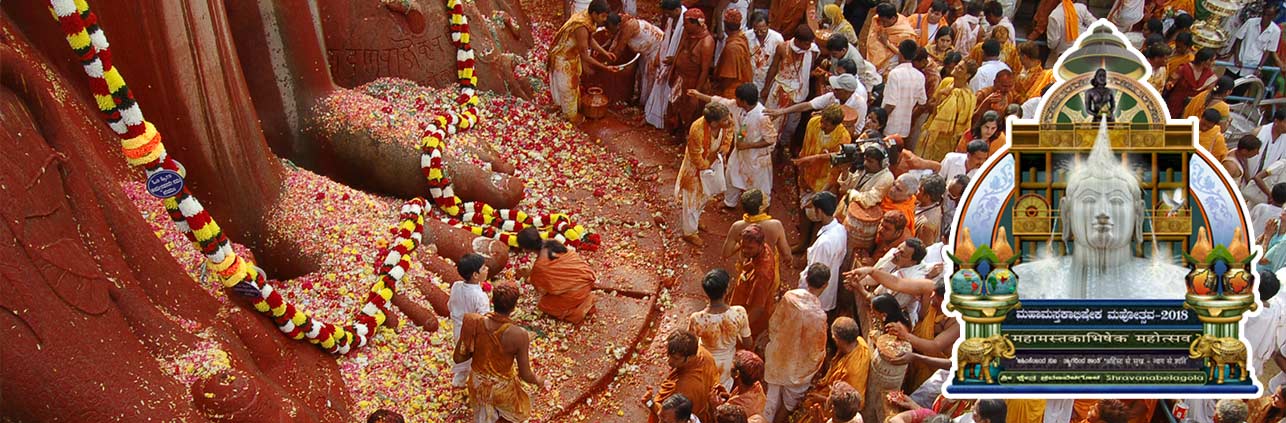
|
JAIN MUNIS ARRIVE AT
SHRAVANABELAGOLA
Shravanabelagola, Jan 20: The arrival of Muni's continued at
Shravanabelagola to participate in the new millenniums first
Mahamasthakabhisheka of Bhagwan Bahubali Swami. Acharya 108 Hithsagar Muni
Maharaj, Acharya 108 Punya Sagarji Muni Maharaj, Acharya 108 Chinmaya Sagar Muni
Maharaj and the group of 13 Muni's and Mathaji's reached Shravanabelagola after
traveling barefoot 1200 km from Devalganvuraj of Northen Maharasthra.
The three muni's were also participated in the previous Mahamasthakabhisheka
believed the divine presence of Acharya Vardhamana Sagar Muni Maharaj the new
millenniums first Mahamasthakabhisheka would spread the prosperity around the
globe.
CHAVUNDARAYA AWARD CONFERRED
Shravanabelagola, Jan 20:
The 11th Chavundaraya Literary Award of Kannada Sahitya Parishat instituted by
the Digambar Jain Mutt of Sri Kshetra Shravanabelagola was conferred on noted
literary figure Pandit P. Nagarajaiah today at Shravanabelagola.
Swasthishri Charukeerthi Bhattraka Swamiji of Shravanabelagola Jain Mutt
bestowed the award to Pandit P Nagarajiah at Chavundaraya Mantapa in the
presence of a plethora of Jain monks.
Speaking on the occasion, the Swamiji said this was the first time the award
function was being held at Shravanabelagola since the inception of the award
during the previous Mahamasthakabhisheka. He lauded Pandit Nagarajaiah for his
contribution to all forms of literature.
Kannada Sahitya Parishat Treasurer Pundaleek Halambi presided. Hassan District
Kannada Sahitya Parishat President H B Ramesh was the chief guest. Mandya
Government Women's College Principal H B Ramesh gave the felicitation address.
PRESIDENT'S ADDRESS AT THE INAUGURATION OF THE MAHAMASTAKABHISHEKA OF BAHUBALI
AT
SHRAVANABELAGOLA, HASSAN,
KARNATAKA
22-01-2006 : Karnataka
Warrior of Non-violence
I am happy to be here today to
inaugurate the Gommateshwar Bhagawan Sri Bahubali Mahamastakabhisheka Mahotsava
- 2006. My greetings to His Holiness Shanti Sagar Muni Maharaj, His Holiness
Charu Keerti Bhattaraka Swamiji, His Holiness Acharya Shree Vidhya-nandhaji
Maharaj, Dr. Veerendra Heggade, Dharmadhikari of Sri Kshetra, Dharmasthala,
distinguished guests and other participants. I consider myself privileged to
inaugurate this auspicious function which is held once in 12 years and is the
first of its kind in the 21st century.
When I am in front of Gommateshwara, let me recite a celebrated poem written by
a devotee as "A strain of sanctity".
The poem reads:
A strain of sanctity
You stand sky high, un-clad in mind and body,
Bahubali ! A warrior of non-violence.
You wrought your mind in sobriety; the damsel
Of detachedness enamoured you: your soul bloomed.
This poem celebrates a warrior of non-violence.
When I am in Shravanabelagola, let
me recall how I came into the spiritual contact of Jain Dharma. In 2003, I
visited Pavapuri in Bihar. There was a beautiful temple of white marble in the
midst of a placid lake. Lord Mahavira walked on this sacred land. I was studying
Mahavira's life and I found that Mahavira spent seven days preaching to all the
rulers of the world when he felt that he was to leave this world soon. All the
rulers learnt the beliefs of Jainism particularly protecting the lives of all
living beings including animals and plants. Mahavira was a great teacher and he
taught that before becoming free, a person has to pass through four stages
namely Sadhu (Ascetics), Upakhyaya (Teachers), Acharya (Heads of Orders) and
Arhat (Freed Soul, which are still attached to mortal condition). What a
beautiful ascent of human soul !
I undertook the traditional parikrama of the temple while chants of religious
slokas rent the air. During the Parikrama, I saw lotus flowers around me
blooming in the sprawling Lake. When my mind was engulfed in beauty of the
flowers, I remembered a couplet written by a famous Tamil poet Tiruvalluvar 2000
years ago, which gives the axiom of life.
It means: whatever be the depth or the state of cleanliness of the pond, the
lotus flower springs out and blooms majestically looking towards the sun.
Similarly the human living can be transformed into a purposeful high living,
whatever the circumstances may be, only when a great aim engulfs the mind of the
individual.
Now, when I am at Shravanabelagola standing in front of the majestic
Gommateshwara statue built by Chavundaraya in 981 AD, the serenity and peace
radiating in the face of the Gommateshwara inspires me. The sculptor Aristenemi
carved out the beauty and harmony hidden in the huge rock by the skill of his
hands, so creatively.
Jainism has flourished in Karnataka for over 2000 years as a vital and powerful
force. In the 3rd century BC the Mauryan Emperor Chandragupta came here with
twelve thousand other Jain sages, and settled down in Shravanabelagola,
performing austerities. The large congregation of the devotees today indeed
symbolizes the continuity of a great tradition.
Jainism has had a great influence on the people. The contribution of Jains to
the Indian philosophy, thought, literature and science is noteworthy. The great
poet Pampa, Ranna, Ratnakara Varni and many others have enriched Kannada
literature. Jain rulers also contributed immensely in the architecture. With its
ever lasting smile and benign looks Gommateshwara Bahubali declares Ahimsa and
Vairagya as the solution for all the ills of this world. I am happy that
Mahamastakaabhisheka has become an auspicious festival, not only for he
Jains but also for people from different religions. This is a great unifier. I
wish that this message of unification is taken and all the sects in every
religion forget the differentiation and follow the twin principles of Ahimsa and
Vairagya.
Conclusion
I understand that the celebration of Mahamastakabhisheka has led to the creation
of five satellite towns in and around Shravanabelagola. All the activities
towards the Abhishekam has been supported by State Government, Central
Government, political leaders, religious leaders and people from all walks of
life. This spirit of cooperation for a common cultural endeavour should
percolate in all our nation building activities.
This five satellite towns can have a physical connectivity, electronic
connectivity, knowledge connectivity leading to economic connectivity of the
cluster of villages around the satellite towns. Economic development under the
divine blessings of towering Gommateshwara, will become an example of how living
conditions can be improved through the provision of urban facilities in rural
areas.
I have one suggestion: to
establish a research centre where the work of best of great saints of Jainism is
synthesized. This would enable the propagation of the value system adopted by
the great tradition of Jainism in the affairs of the contemporary world.
It is a beautiful sight of people of multiple faith and affiliations gathered to
celebrate a great cultural event. The most sacred meaning of life consists of
helping the establishment of the peace and harmony on the earth. This can only
be achieved through the practice of Truth, Ahimsa and Vairagya by all of us. The
stone sculpture of Bahubali symbolizes renunciation, self-control and
subjugation of ego as the first step towards salvation. The digambara form of
Bahubali represents the complete victory over earthly desires and needs that
hamper spiritual ascent towards divinity. Let this message travel to all parts
of the country and bring forward peace and harmony among all the citizens of the
nation.
With these words, I inaugurate the Gommateshwar Bhagawan Sri Bahubali
Mahamastakabhisheka Mahotsava.
May God bless you all.
ABDUL KALAM
FLAGS OFF MAHAMASTHAKABHISHEKA
Shravanabelagola, Jan 22:
The new millennium's first Mahamastakabhisheka celebrations was flagged off
today by President Dr.A PJ Abdul Kalam with a clarion call for world peace.
Dr.Kalam, speaking after lighting the lamp marking the commencement of the
celebrations and declaring open the 100 bed Bahubali Children's Hospital, said
the values of non violence and renunciation enshrined in the life and ideals of
Bhagawan Bahubali holds the key to world peace.
The President termed it as a
privilege to have got the opportunity to inaugurate Mahamastakabhisheka,
celebrating the life of Bahubali, a great unifier bringing people from all walks
of life and different religions together.
"It is a beautiful sight of people
of multiple faith and affiliations gathered to celebrate a great cultural event.
The most sacred meaning of life consists of helping the establishment of the
peace and harmony on the earth. This can only be achieved through the practice
of Truth, Ahimsa and Vairagya by all of us," he said.
Dr.Kalam said the stone sculpture
of Bahubali symbolizes renunciation, self-control and subjugation of ego as the
first step towards salvation. The digambara form of Bahubali represents the
complete victory over earthly desires and needs that hamper spiritual ascent
towards divinity. "Let this message travel to all parts of the country and bring
forward peace and harmony among all the citizens of the nation", he said.
Dr.Kalam said Shravanabelagola should be declared as a world heritage site and a
Jain research center should be established at Shravanabelagola propagating the
values of Jainism as enshrined in various fields and to ensure that all the best
works of great saints of Jainism is synthesized. This would enable the
propagation of the value system adopted by the great tradition of Jainism in the
affairs of the contemporary world, he added.
Turning to the majestic monolith of Bahubali, the President said he was inspired
by the serenity and peace radiating in the face of the Gommateshwara. "Now, when
I am at Shravanabelagola standing in front of the majestic Gommateshwara statue
built by Chavundaraya in 981 AD, the serenity and peace radiating in the face of
the Gommateshwara inspires me. The sculptor Aristenemi carved out the beauty and
harmony hidden in the huge rock by the skill of his hands, so creatively," he
lauded.
Terming Bahubali as a 'warrior of
Non-violence', he recited a celebrated poem written by a devotee as "A strain of
sanctity":
"A strain of sanctity You stand sky high,
un-clad in mind and body,
Bahubali! A warrior of non-violence.
You wrought your mind in sobriety; the damsel
Of detachedness enamoured you: your soul bloomed.
This poem celebrates a warrior of non-violence."
Recalling how he came into
spiritual contact of Jain Dharma, the President said in 2003, he visited
Pavapuri in Bihar. "There was a beautiful temple of white marble in the midst of
a placid lake. Lord Mahavira walked on this sacred land. I was studying
Mahavira's life and I found that Mahavira spent seven days preaching to all the
rulers
of the world when he felt that he was to leave this world soon. All the rulers
learnt the beliefs of Jainism particularly protecting the lives of all living
beings including animals and plants. Mahavira was a great teacher and he taught
that before becoming free, a person has to pass through four stages namely Sadhu
(Ascetics), Upakhyaya (Teachers), Acharya (Heads of Orders) and Arhat (Freed
Soul, which are still attached to mortal condition). What a beautiful ascent of
human soul!" he marveled.
The President said he then undertook the traditional parikrama of the temple
while chants of religious slokas rent the air. During the Parikrama, he saw
lotus flowers around him blooming in the sprawling Lake. His mind engulfed in
beauty of the flowers, a couplet written by a famous Tamil poet Tiruvalluvar
2000 years ago, which gives the axiom of life came to his mind.
After reciting the couplet in Tamil, he explained the meaning. "It means:
whatever be the depth or the state of cleanliness of the pond, the lotus flower
springs out and blooms majestically looking towards the sun. Similarly the human
living can be transformed into a purposeful high living, whatever the
circumstances may be, only when a
great aim engulfs the mind of the individual.
Dr.Kalam said Jainism has had a great influence on the people. The contribution
of Jains to the Indian philosophy, thought, literature and science is
noteworthy. The great poet Pampa, Ranna, Ratnakara Varni and many others have
enriched Kannada literature. Jain rulers also contributed immensely in the
architecture. With its ever-lasting smile and benign looks Gommateshwara
Bahubali declares Ahimsa and Vairagya as the solution for all the ills of this
world, he said.
"I am happy that Mahamastakabhisheka has become an auspicious festival, not only
for the Jains but also for people from different religions. This is a great
unifier. I wish that this message of unification is taken and all the sects in
every religion forget the differentiation and follow the twin principles of
Ahimsa and Vairagya," he said.
He lauded the activities towards the Mahamastakabhisheka being supported by
State Government, Central Government, political leaders, religious leaders and
people from all walks of life. This spirit of cooperation for a common cultural
endeavour should percolate in all our nation building activities, he added.
DHARMIC
BEGINNING FOR MAHAMASTHAKABHISHEKA
Shravanabelagola, Jan 22:
The new millennium's first Mahamastakabhisheka Celebration of Bhagawan Bahubali
Swami began with the consecration of the statue of Bhagwan Mahaveer at the
panchakalyana pendal at Sharavanabelagola.
In the dharmic rituals that began early morning with consecration of Mahaveera's
statue, which was carried from the Bhandara Basadi to the pendal in Thyagi Nagar
in a grand procession with a poorna kumba features. His Holiness Acharya
Vardhamana Sagar Muni Maharaj, Swasthishri Charukeerthi Bhattaraka Swamiji and
all the Jain acharyas and Mathaji's lead the procession into the Panchakalyana
Pendal.
The procession led by horses and an elephant with school children marching to
the tune of drum beats behind followed by ladies attired colourfully in saffron
sarees carried the mangal kumbas through the procession offering salutations to
the Bhagawan, which was carried in a newly built silver palanquin. The Acharyas
and other monks followed with Swasthishri Charukeerthi Bhattaraka Swamiji and
others of the mutt making the rear.
People standing on both sides of the road welcomed the procession with great
reverence even as bhajanas reverberated the early morning air and the sun seemed
shining welcoming the procession even as the wind wafted those in the procession
in a cool morning breeze.
After the procession reached Thyagi Nagar, Charukeerthi Bhattaraka of Moodbidri
and Thyagi Seva Samithi President Shripalji Gangwal unfurled the
Mahamastakabhisheka flag amidst dharmic slogans.
Later Mr.Mahaveer Prasad of Assam inaugurated the Shantisagar satellite town.
Nirmal Kumar Sethi, Reception committee President of Mahamasthakabhisheka
Mahotsava, Chainroop Bakliwal, Vicepresident and A.R Nirmal Kumar, Working
President of Mahamasthakabhisheka Mahotsav also took part in the procession.
During the president's inaugural function, simultaneous 108 kalashabhisheka was
performed to the feet of Bahubali atop the Vindhyagiri hills and the same was
telecast live on the gaint screen at the president's function.
GOLD FOOTPRINTS
OF BHADRABAHU WORSHIPED ATOP CHANDRAGIRI

His Holiness Swasti
Sri Charukeerthi Bhattarakha Swamiji exhibiting the gold foot prints of
Badrabahu that was worshiped at Chandragiri. |
Shravanabelagola, Jan 23:
Jain monks and devotees moving around from one place of action to the other is
the order of the day at Shravanabelagola.
After the morning poojas in different Jain temples in the morning, the action
today shifted to Chandragiri hills with a colourful procession led by Acharyas
and Swasthishri Charukeerthi Bhattaraka Swamiji climbing up the hills for paying
homage to the first Acharya of Shravanabelagola and guru of Emperor Chandragupta
Mourya, Sruthakevali Bhadrabahu.
Drum beating devotees and the Jain monks braved the hot afternoon sun and
climbed the hills armed with a golden replica embedded with precious tones of
the foot imprints of Saint Bhadrabahu found inside the cave where the saint
meditated, preached and later attained Nirvana.
On reaching the cave, the Archaryas along with Swasthishri Charukeerthi
Bhattaraka Swamiji entered the cave amidst chanting of slogans and bhajanas. The
Swamiji worshipped the foot imprints and the golden replica of the same as the
Acharyas looked on.
|

His Holiness Swasti Sri
Charukeerthi Bhattarakji and other Digambar Munis involved in the worship
of the foot prints of Badrabahu. |
Later speaking to media persons,
the Swamiji said Sruthakevali Bhadrabahu was a scholar beyond comparison and
knew all the Jain scriptures, known as the `12 Angas and 14 poorvas'. "Sruthakevali
Bhadrabahu migrated from North to South along with Chandragupta Mourya and 12,
000 other followers and stayed atop the Chandragiri hills.2000 years ago
Chandragiri was full of monks. This first Acharya of Shravanabelagola gave
deeksha to Chandragupta Mourya and since then the Emperor turned Sadhu was known
as Prabhachandra. Both Bhadrabahu attained Nirvana and Sallekana (the final
moments of his life) atop the hills and so did his disciple Chandragupta.
"Emperor Ashoka named Chandragiri hills in the memory of his father and hence,
even before the Bahubali Monolith was carved Shravanabelagola was a Jain pilgrim
Centre. The first Prakruth University was also functioning from Chandragiri and
poet Ratnakara, who has left behind his signature on the Chandragiri hills,
which is as old as 2300 years with 555 scriptures and 5 caves, endorses this.
The cave is also closely associated with the royal families Ganga, Hoysala and
Vijayanagar kingdom," the Swamiji explained.
CULTURAL
PROGRAMMES INAUGURATED
Shravanabelagola, Jan 23:
The month long celebration of Mahamasthakabhisheka would be coloured by the
cultural events to be performed by National and International standard artistes.
Mr. Naresh Kumar Sethi, Honorary President of Mahamasthakabhisheka Mahotsav
Committee inaugurated the month long celebration of cultural programmes at
Panchakalyana Pendal today. Swasthishri Charukeerthi Bhattaraka Swamiji graced
the occasion. A.R Nirmal Kumar, Working President of Mahamasthakabhisheka
Mahotsav Committee and Mr. Aravind R Doshi were also present on the occasion.
DHARMIC
RITUALS OF MAHAMASTHAKABHISHEKA
Shravanabelagola, Jan 24:
The dharmic rituals of Mahamastakabhisheka Mahotsav 2006 that began with the
consecration of the statue of Bhagwan Mahaveer at the Panchakalyana Pendal and
later the 108 Kalasha Abhisheka to the feet of Bhagwan Sri Bahubali Swami (Gommateshwara
Statue) atop the Vindhyagiri hills, simultaneously even as the President A P J
Abdul Kalam light the ceremonial lamp at Panchakalyana Nagar is gathering
momentum by the day.
In the dharmic rituals that began early morning on Sunday the highlight was the
consecration of Mahaveera's statue, which was carried from the Bhandara Basadi
to the pendal in Thyagi Nagar in a grand procession with a poorna kumba
features. His Holiness Acharya Vardhamana Sagar Muni Maharaj, Swasthishri
Charukeerthi Bhattaraka Swamiji and all the Jain acharyas and Mathaji's lead the
procession into the Panchakalyana Pendal.
The procession led by horses and an elephant with school children marching to
the tune of drum beats behind followed by ladies attired colourfully in saffron
sarees carried the mangal kumbas through the procession offering salutations to
the Bhagawan, which was carried in a newly built silver palanquin. The Acharyas
and other monks followed with Swasthishri Charukeerthi Bhattaraka Swamiji and
others of the mutt making the rear.
People standing on both sides of the road welcomed the procession with great
reverence even as bhajanas reverberated the early morning air and the sun seemed
shining welcoming the procession even as the wind wafted those in the procession
in a cool morning breeze.
After the procession reached Thyagi Nagar, Charukeerthi Bhattaraka of Moodbidri
and Thyagi Seva Samithi President Shripalji Gangwal unfurled the
Mahamastakabhisheka flag amidst dharmic slogans.
The scene shifted to Chandragiri Hills on Monday and Tuesday with the footprints
of Bhadrabahu in the Cave being worshiped yesterday and the imprints of
Bhadrabahu and Chandragupta Mourya on the tip of the hills being worshiped
today.
After the morning poojas in different Jain temples yesterday morning, a
colourful procession led by Acharyas and Swasthishri Charukeerthi Bhattaraka
Swamiji climbing up the hills for paying homage to the first Acharya of
Shravanabelagola and guru of Emperor Chandragupta Mourya, Sruthakevali
Bhadrabahu.
Drum beating devotees and the Jain monks braved the hot afternoon sun and
climbed the hills armed with a golden replica embedded with precious tones of
the foot imprints of Saint Bhadrabahu found inside the cave where the saint
meditated, preached and later attained Nirvana.
On reaching the cave, the Archaryas along with Swasthishri Charukeerthi
Bhattaraka Swamiji entered the cave amidst chanting of slogans and bhajanas. The
Swamiji worshipped the foot imprints and the golden replica of the same as the
Acharyas looked on.
Later speaking to media persons, the Swamiji said Sruthakevali Bhadrabahu was a
scholar beyond comparison and knew all the Jain scriptures, known as the `12
Angas and 14 poorvas'. "Sruthakevali Bhadrabahu migrated from North to South
along with Chandragupta Mourya and 12, 000 other followers and stayed atop the
Chandragiri hills.
2000 years ago Chandragiri was full of monks. This first Acharya of
Shravanabelagola gave deeksha to Chandragupta Mourya and since then the Emperor
turned Sadhu was known as Prabhachandra. Both Bhadrabahu attained Nirvana and
Sallekana (the final moments of his life) atop the hills and so did his disciple
Chandragupta.
"Emperor Ashoka named Chandragiri hills in the memory of his father and hence,
even before the Bahubali Monolith was carved Shravanabelagola was a Jain pilgrim
Centre. The first Prakruth University was also functioning from Chandragiri and
poet Ratnakara, who has left behind his signature on the Chandragiri hills,
which is as old as 2300 years with 555 scriptures and 5 caves, endorses this.
The cave is also closely associated with the royal families Ganga, Hoysala and
Vijayanagar kingdom," the Swamiji explained.
Today, similar scenes were witnessed atop the hills with the procession climbing
up to the edge of the Chandragiri hills to worship the footprints of Bhadrabahu
and Chandragupta Mourya. Swasthishri Charukeerthi Bhattaraka Swamiji who
worshipped the footprints in the presence of the Acharyas and monks later
visited the Chandragupta Basadi, built by Emperor Ashoka, and detailed out the
screen stone sculptures narrating the arrival of Bhadrabahu and Chandragupta
Mourya to the Chandragiri with 12, 000 followers. Later, at the Panchakalyana
Pendal in the afternoon, Acharyas, monks and other speakers offered salutations
to the life and times of Chandragupta.
On Wednesday, an early morning procession would leave for Chandragiri hills from
Bandara Basadi (temple) to commemorate the arrival of Emperor Ashoka. Later, in
the afternoon, the monks including revolutionary monk Tarun Sagar will pay
salutations to Emperor Ashoka in the afternoon.
EMPEROR
ASHOKA REMEMBERED
|

His Holiness Swasti Sri
CHarukeerthi Bhattarakha Swamiji and other ascetics encircling the
Parshwanatha Basadi atop the Chandragiri Hillock. |
Shravanabelagola, Jan 25:
Wednesday at the Mahamastakabhisheka celebrations belonged to Emperor Ashoka
with the Acharyas and Swasthishri Charukeerthi Bhattaraka Swamiji commemorating
his visit to Chandragiri hills by grand offering of a silver Chatharathraya, the
dharmic head shades resembling three dropping umbrellas linked one below the
other, and pearls Abhisheka to Teerthankara Parswanatha Swamy's idol in
Chandragupta Basadi the Jain Temple built by Ashoka in the memory of his
grandfather, Chandragupta Mourya, atop the hill and circling the Basadi
thrice.After the morning poojas in different Jain temples in the morning, drum
beating devotees and the Jain monks braved the early morning chill and climbed
the hills armed with the Chatharathraya. Once the entourage with all the 12
Acharyas led by Swasthishri Charukeerthi Bhattaraka Swamiji reached the Basadi,
slogans were raised and the Chatharathraya was raised in a grand show, following
which the entire procession circled the Basadi thrice.
Speaking on the occasion, Swasthishri Charukeerthi Bhattaraka Swamiji said the
temples at Chandragiri Hills were models to be emulated. "Samrat Ashoka built
Chandragiri Basadi in memory of his grandfather. We can find this kind of
architecture only in Karnataka. Chandragupta Basadi Vaastu principles have been
followed thoroughly in this temple, built by Ashoka.
|

His Holiness Swasti Sri
CHarukeerthi Bhattarakha Swamiji and other ascetics encircling the
Parshwanatha Basadi atop the Chandragiri Hillock. |
The Swamiji said when Emperor Ashoka visited Shravanabelagola, a
complete colony was built for him and his entourage and this could be
what is today known as Halebelagola. "There is a need for conducting
extensive research on all the 555 scriptures and other heritage
structures atop Chandragiri, and it is always better late than never",
he said and added that he had held talks with ASI about Halebelagola
to renovate the temples there.
Swamiji though Chandragupta Basadi is very small it has been built
very scientifically and this 2300 years old Basadi has the best Vaastu
recorded so far.
Later, speaking at the 'Ashoka Namana' function in the afternoon,
Acharya 108 Vardhamana Sagar Muni Maharaja said Ashoka was an
indelible part of India, enshrined as the Ashoka Chakra in the
national flag and the Ashoka Sthamba, the national insignia. Other
Acharyas and matajis, including revolutionary Jain Muni Tarun Sagar,
also spoke on the occasion.
TEERTHANKARAS RECEIVE 'CHATHARATHRAYA'
|

Digambar Jain Munis look on
to the rituals being performed during the offering of the Chatratraya.
|
Shravanabelagola, Jan 26:
In a colourful ceremony led by the 12 Acharyas and Swasthishri Charukeerthi
Bhattaraka Swamiji, all the 24 Jain Teerthankaras worshiped in the 13 Basadis or
Jain temples atop the Chandragiri Hills were offered silver Chatharathraya, the
dharmic head shades resembling three dropping umbrellas linked one below the
other.
After the morning poojas in different Jain temples in the morning, drum beating
devotees and the Jain monks braved the early morning chill and climbed the hills
armed with the Chatharathrayas. Once the entourage with all the 12 Acharyas led
by Swasthishri Charukeerthi Bhattaraka Swamiji reached the Basadi, slogans were
raised and the Chatharathrayas were raised in a grand show, following which the
entire procession circled each Basadi.
|

A priest performing the
dharmic rituals after the offering of the Chatratraya at Chandragiri,
Shravanabelgola as Charukeerthi Bhattarakji looks on. |
The Acharyas, the Swamiji and MMC06 Honorary President Naresh Kumar Sethi took
turns in making the offering to individual Teerthankaras followed by floral
abhishek, offering of fruits and performance of arathi. Beginning with
Santhinath Basadi, the dharmic procession offered the Chatharathrayas to
Teerthankaras at Suparshwanath Basadi, Chandraprabhu Basadi, Chavundaraya
Basadi, Chandragupta Basadi, Kattale Basadi, Shanthinath Basadi, Parshwanath
Basadi, Chandraprabha Basadi, Shasana Basadi, Majjigana Basadi, Eradukatte
Basadi, Savathigandavarna Basadi, Terina Basadi and Shantishwar Basadi.
|