|
|
981 A.D. -
The first ever
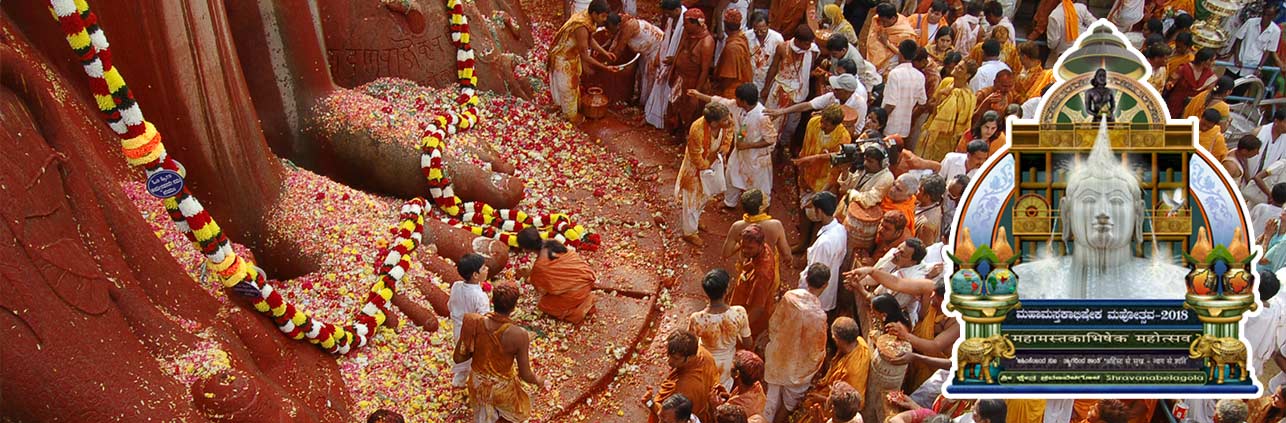
Mahamasthakabhisheka of the sacred 57 feet high monolithic
statue of Lord Bahubali was performed in 981 A.D. under the
guidance of Chamundaraya. On account of the stupendous height of
the image special scaffoldings have to be erected whenever
Mahamasthakabhishekas are to be performed. Hence such anointing
ceremonies are few and far between performed only at certain
conjunctions of the heavenly bodies at intervals of several
years and at a very great cost.
1398 A.D. -
"The earliest reference to
Mahamasthakabhisheka is found in an inscription of 1398, which
states that Panditarya had it performed seven times.
1612, 1677, 1825,
1871, 1887 A.D. -The poet Panchabana refers to an anointment caused to be performed by one
Santavarni in 1612, Ananthakavi to another conducted at the
expense of Visalaksha Pandita, the Jaina minister of the Mysore
kin Chikka-Devaraja-Wodeyar, in 1677 and Santaraja Pandita to a
third caused to be performed by the Mysore king Krishna Raja
Wodeyar III in about 1825(Epigraphia Carnatica Vol II page 18).
Reference is made to a similar ceremony performed in 1827, to
another in 1871 in the Indian Antiquary and to another still
performed in 1887 at the expense of Sri Lakshmisena Bhattarka of
Jain Mutt Kolhapur who is said to have spent nearly Rs. 30,000
for the purpose.
1901 A.D. - Within recent
times there was a grand anointing ceremony on 30th March 1910.
It will interesting to note that on that occasion an aerial post
was tried by one Mr.G.F.Edwards who sent a message regarding the
puja by a homing pigeon which was received by the Madras Mail
Office within three hours and forty minutes details of which
were published in the Jaina Gazettee Vol VI No. 6.
1925 A.D. -
After the lapse of
a decade and a half a very grand Mahamasthakabhisheka was
performed on the 15th of March 1925. Months before this date a
pooja comittee had been formed with His Holiness Charukirti
Panditarya-Varya Swamiji of the Jain Mutt at Shravanabelagola as
president and Mr.M.L.Vardhamanaiah of Mysore the Secretary.
Bulletins were caused to be issued in various vernaculars and
circulated all over India to give the widest publicity possible
about the then impending great and religious function of the
Jains. With great self sacrifice, Mr.Vardhamanaiah, the
energetic and indefatigable Secretary of the Pooja Committee,
toured all over India visiting the important Jain centers to
invite the Jain Samaj and to make the necessary arrangements for
the success of the festival. The news of Mahamasthakabhisheka of
Sri Gommateshwara was welcomed with a thrill of joy all over the
Jaina world and the one common talk of the Jains early that year
was about their intending pilgrimage to Shravanabelagola.
The
Mahamastakabhisheka mahotsava began on the 27th February and
terminated on the 15th of March with the grand
Mahamasthakabhisheka of the sacred and magnificient image of Sri
Gommateshwara. Between those two dates there were various
festivals including a Panchakalyana pooja. As days passed on the
influx of pilgrims went on increasing gradually untill at last
towards the middle of March large crowds began to gather in the
small town of Shravanabelagola. Jains from all parts India from
Calcutta, Cuttack, Kanchi, Kashmir, Belgaum, Benaras, Bombay,
Poona, Madras, Meerut, Akola, Alahabad, Lahore, Lalithpur,
Delhi, Dacca, Indire, Ajmer, Jaipur, Jodhpur, Bikaner, Bharatpur,
Lucknow, Moradabad, Puri, Peshawar, Surat, Ahmadabad, Trichy,
Tanjore, Madura, Ramnad, Mangalore, Moodabidri, Karnala, Venur
and many other parts of India speaking various vernaculars
languages from different professions irrespective of their
financial status or education thronged to Shravanabelagola. Many
sadhus, sadhvis and shravakas thronged at Shravanabelagola to
pay their reverential homage to Gommateshwara and witness the
sacred Mahamasthakabhisheka.
With an intention
of increasing the importance of the event it was announced that
the All India Jain Conference would be held under the
distinguished presidency of His Highness the Maharaj of Mysore.
The accasion attracted unprecedented number of Jains and the
erstwhile village of Shravanabelagola got metamorphosed into a
typical Indian city by the middle of March 1925. The pooja
committee had made elaborate arrangements for the convenience of
the piglrims and had erected a large number of sheds and tents
which were fully occupied. His Highness the Maharaja of Mysore
had camped at Sravanabelagola for three days. All kinds of
bazaars and tamashas and circus added to the buzzle of
the place. With the beloved ruler of the state in the midst and
with thousands of pilgrims and hundreds of shops,
Shravanabelagola could very favourably be compared with any of
the average capital cities of the native states in India.
His highness the
Maharaja arrived at Shravanabelagola on the 13th March at 6-30pm
and His Highness was given a hearty and royal reception at a
special entrance to the village, where a welcome arch had been
erected for the purpose. On the way from Mysore to
Shravanabelagola special arches were erected at the entrance of
each village to welcome His Highness on his way to
Shravanabelagola. From Kikkeri, His highness traveled along the
new route constructed by Sowkar G.P.Dharaniah of
Shravanabelagola. Sir Seth Hukumchandji, Mr.M.L.Vardhamanaiah
and Dorbali Jinadas Sastri, the palaca Mahadivan and other
dignitaries welcomed His Highness in a traditional manner.
On the following
four or five days there were anointing ceremonies performed by
the pilgrims from different places in India.
The greatest,
grandest and the most sublime and memorable event took place on
the 15th March. Early in the morning people were seen going up
the Vindhyagiri shouting "Sri Gommateshwara Swamiki Jai, Sri
Bahubali Maharajki Jai". About 9'o clock in the morning all the
available space on the hill was occupied. It was estimated that
not less than 5000 people were seated on the Mantap around the
sacred Image. Tens of thousands of pilgrims were on the
Chandragiri and in the shade of trees anxiously waiting to see
the pooja.
At about 9-30 A.M.
the pooja began amidst the loud sounding of bands, pipes and
drums and the mingled shouts of, "Jai, Jai", the first pooja was
performed in the name of His Highness the Maharaja of Mysore. As
the collossal and the majestic inage was being bathed with
water, cocoanut meal, plantains, jaggery, ghee, sugarcane juice,
almonds, date, etc. In quick succession the devout pilgrims
found themselves in a land of immortality and joy.
At about 11-30
A.M., His Highness the Maharaja arrived at the foot of the hill
by motor and walked up the hill bare footed. His Highness
sitting on the special seat arranged for him witnessed the pooja.
Then the abhisheka or the anointment with milk took place which
was a supremely grand and inspiring sight which almost made the
spectators forget themselves and cry, "Gommateshwara Swamiki
Jai". Then there was abhisheka with sandalwood, saffron mixture
and swarna, gold and sivler flowers, varieties of gems and
coins. His Highness presented a few costly shawls to His
Holiness Sri Charukeerthi Panditarya Swamiji of Jain Mutt at
Shravanabelagola. Then the masthakabhisheka came to a successful
close for that day amidst shouts of "Jai, Jai".
On the following
four or five days there were anointing ceremonies performed by
the pilgrims from different places in India.
1940 A.D. -
The
government of MYsore sanctioned the performance of the
Mahamasthakabhisheka in February 1940. For the first time the
Mysore government took up the celebration of this function which
on the previous occasions was performed by the leading Jains. As
usual for about a fortnight prior to the day of
mahamasthakabhisheka which was held on the 26th February 1940,
several religious ceremonies were performed. At 9-30 A.M. on the
26th February the first Abhisheka was performed by the late His
Highness Sri Krishnarajendra Bahadur accompanied by the prince
Sri Jayachamarajendra Wodeyar. The people assembled were happy
to witness the pooja and also to see their Highness in their
midst. At 4 P.M. on the same day their Highness were presented
with welcome addresses on the occasion of the All India Digambar
Jain Mahasabha which was graciously opened by His Highness the
Maharaja. Several conferences were held during the occasion.
Over Rs. 75,000 were collected by the auction sale of Kalashas
to constitute a fund for the protection and upkeep of the sacred
image. This pooja also was a grand success and a good occasion
for the discussion of several matters concerning the welfare of
the Jain Community.
Reference:
Glory Of
Gommatesvara - Edited by: C.S.Mallinath, Mercury Publishing
House, Madras (1953).
|