|
Karnataka is as famed for its
many shrines, temples, mosques, churches and jain basadis as it is for its natural grandeur. At these
architectural wonders, legend blends freely into history and vice versa-
giving them an evocative ambience and cultural significance that brings
to life the richness of the state’s heritage.
Karnataka’s religious circuit fascinates pilgrims and visitors alike as
the enigma that is Indian philosophy unravels itself in itself in all
its architectural, religious, cultural and historic splendour.
Gokarna
This coastal town draws Hindu pilgrims, Sanskrit scholars, and beach
buffs alike. Apart from its famed beaches and the Centre for Sanskrit
Learning, it is home to ancient Temple of
Mahabaleshwar
with its Atmalinga, the Venkatramana Temple, the
Ganapathi Temple
and
the Koti Teertha, a large temple tank where pilgrims perform
their ablutions. Other must-sees in Gokarna are the enormous chariots,
which are dragged in a procession along the main street between February
and March.
Udupi
Approximately 60km from Mangalore is the Vaishnavite pilgrimage
town of Udupi. This was the sanctum of Madhwacharya, the great Sanskrit
Philosopher. It is as much renowned for its chefs, cuisine and
restaurants as it is for its Krishna Temple and various mutts.
The main attraction at this temple is the ‘kanakana kindi’- a small
window through which Krishna is believed to have given darshan to his
ardent devotee, kanakadasa, a saint-minstrel.
The
colorful Paryaya festival held every alternative year, when
officiating priests hand over their responsibilities to another pontiff
attracts thousands of devotees from all over the country.
Mookambika Temple
In the village of kollur located 130km from Mangalore and nestled amid
the green canopy of the Western Ghats is the
Mookambika Temple.
One of the seven most sacred SPOTS OF THE COASTAL regions, IT IS
DEDICATED TO THE GODDESS OF EMOTIONAL POWER AND STRENGTH. THE TEMPLE HAS
A GOLD-PLATED CREST AND COPPER ROOFS. Adi Shankaracharya, the great
philosopher, is said to have visited this temple to perform penance.
Dharmastala
Dharmastala, situated 65km east of Manglore, in Belthangady taluk
of Dakshina Kannada district, is a remarkable example of communal
harmaony and cultural tolerance.
Besides the many Jain basadis and a museum, the centrepeice of this
templetown is a 39ft monolith statue of Lord Bahubali. The Jain
Tirthankara and Lord Manjunatha (Shiva) are worshipped on the same
consecrated ground.
Here religious charity is a way of life. The
Manjunatha Temple,
a prominent Shaivite centre, is administered by a benevolent Jain
Heggade, whose charity and concern for social welfare have become
legendary. Irrespective of caste, creed, or religion, pilgrims are given
free meals and lodging. During the festival of Laksh Deepotsava,
100,000 oil lamps light up the night with their tiny flames.
Murudeshwar
Located on the main Mangalore-karwar highway, Murudershwar is sandwiched
between the picturesque Western ghats and the Arabian sea. Its main
attractions are its beach, an awesome Shiva statue and a
Shiva Temple
built with chalukya and kadamba sculptures in the Dravidian style of
architecture. The temple is located on a hillock, which offers a
magnificient view of the sea.
I
SKCON Temple (International Society for Krishan Consciousness)
This extravagantly ornate and internationally renowned temple is just
10km west of Vidhana Soudha in
Bangalore.
Built on a hillock with granite, marble and Korean glass, this huge
cultural complex was established to promote Vedic culture and spiritual
learning. It houses various deities, including Krishna, Balaram and
Radha. The annual Rath Yatra (Chariot procession) of Krishna and
Balaram draw millions.
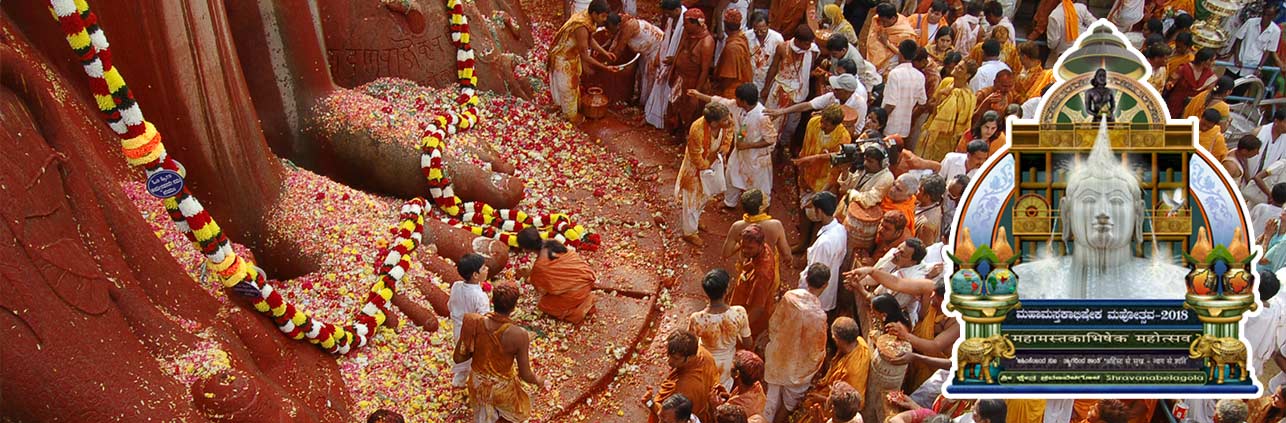
Shravanabelagola
This
prominent Jain pilgrimage centre in Hassan district is located
148km from Bangalore. Shravanabelagola is home to Asia’s largest
monolithic statue –Lord Gomateshwara here towers 58ft high, looming atop
the picturesque Vindyagiri Hill.
Every
12 years, Jain pilgrims from the world over gather here to participate
in the colourful Maha Masthakabhisheka of the Lord, the splendid
head-anointing ceremony. From specially erected scaffolding, priests
pour hundreds of pots of curd, milk, honey, vermilion, coconut water,
turmeric paste, and even gold and precious jewels over thee statue’s
head.
Mudabidri
Mudabidri is known as the ‘Jain Varanasi’ of south India. There are 18
Jain basadis in Mudabidri- the oldest of them is the 15th
century Chandranath Basadi, also known as the Thousand Pillar
Basadi. The main entrance opens onto a superb monolith pillar in front
of the doorway.
The
temple boasts of a valuable collection of jewel-encrusted metallic
images of Jain Tirthankaras and superb monolithic columns in the Jain
tradition, each with a different carving. The Jain Mutt near the
main temple entrance has a library containing several beautiful 12th
and 13th century palm leaf manuscripts.
Venur
The town is famed for its eight basadis and the ruins of a Mahadeva
Temple. An 11m high Bahubali statue, dating back to 1604, stands on
the southern bank of the
Gurpur River.
Karkala
The
towering 42ft monolith of Gomatshwara standing atop a granite outcrop on
the outskirts of the town is the main attraction in karkalla. The
Chaturmukha Basadi, completed in1586, has four identical Jain
Tirthankara images facing in four directions.
Sringeri
It is believed that Sringeri was named after Rishyashringa, who appears
in the Indian mythological epic, Ramayana as the chief priest at the
sacrifice of King Dasaratha. Sringeri, where the founder of the Advaitha
Philosophy, Adi Shankara, is said to have discovered a cobra sheltering
a frog from the torrential rains, has its spiritual centre on the banks
of the
Tungabhadra River.
The
Vidyashakar temple located here amid the evergreen forests of
Chickmagalur is an architectural marvel. Its 12 sculpted pillars, each
representing a sign of the zodiac, are placed so that the sun’s rays
fall on ach successively in the order of their solar months. A second
temple, built in the Dravidian style, is dedicated to Sharada, the
goddess of learning. The Tungabhadra River flows past the temple where
devotees congregate to feed the scared fish.
Inam Dattatreya Peetha
The
Inam Dattatreya Peetha shrine venerated by Hindus and Muslims alike is
situated on the Baba Budangiri hill range. The range is also
called Chandra Drona Parvatha as it resembles a crescent. Located just
28km north of Chikmagalur town and 24 km from Kemmanugundi, baba
Budangiri (1895m) takes its name from Muslim saint Baba Budan who
resided here and is credited to have brought the first seven coffee
seeds into the region after a visit to Yemen.
A
laterite cave here is believed to have been sanctified by the residence
of Dattatreya Swami as well as Hazath Dada Hayath Mir Kalandar. The
worship here is conducted by a fakir and the annual jatra or urs
is attended by both Hindus and Muslims.
Talacauvery
Set amidst the picturesque Brahmagiri Hills is the source of the
Cauvery River with the
Talacauvery Temple
built around it. On the Tulasankramana Day, in October,thousands
of piligrims block to the river’s birthplace to witness the miraculous
rise of the fountainbed, when water gushes up from a spring at a
predetermined moment, Steps lead from the spring to the summit of the
hill, commanding a breathtaking view of the valley.
Banavasi
Nestled deep in the forests of the Western Ghats on the border of
Uttara Kannada and Shimoga districts, this temple town is
located on the Vardha River and is known for its rice, sugarcane,
areca nut, spices and the famous Banavasi pineapple.
The capital of the kadambas, the first kingdom of ancient Karnataka,
this is where the eminent poet Pampa found inspiration for his poems.
The
Madhukeshwara Temple,
famed for its architecture, derives its name from the honey-colored
lingam in the inner sanctum of the temple. An imposing Nandi faces the
lingam.
Khwaje Bandhe Nawaz Durgah
The tomb of the great sufi saint Khwaja Bande Nawaz in
Gulbarga
is a magnificient building in the Indo-Saracenic style. It holds a very
special place in the hearts of Muslim devotees. Thousands of Hindus and
Muslims visit the Durgah each day to pay homage to the saint. It is the
venue of an annual urus (festival) attended by nearly one hundred
thousand people-from both communities.
At
festivals that are held on the 15th day of every lunar month,
devotees spontaneously burst into a dance similar to the dervishes in
the Sufi shrine at Konya in Turkey. The Durgah Library houses
nearly 10,000 books on various subjects in Urdu, Persian and Arabic.
Sharanbasaveshwara Shrine
Dedicated to the Hindu saint and reformer Basaveshwara, this shrine is a
popular year- round pilgrim centre for Hindu devotees. A Chariot
Festival, which draws thousands of pilgrims, is held in
Basaveshwara’s honour near the Gulbarga Tank.
Basavakalyan
Once
the capital of the Kalyana Chalukyas and the centre of great social and
religious upheaval in the 12th century, Basavakalyan in
Bidar district is famed for its cultural heritage. Duringthe time of
the social reformer Basaveshwara, it became a seat of learning and an
abode of spiritual wisdom.
Basavakalyan is renowned for the aints who made the city their home
Basaveshwara, Akka-Mahadevi, Channabasavanna and Siddarama.
Gurudwara Nanak Jhira Sahib
Legend
has it that Guru Nanak halted at Bidar at a time when the area
was reeling under a severe drought. The Muslim saints requested him to
invoke the blessings of the divine in order to obtain water. A crystal
clear stream that still flows out of a rock near the Gurudwara is
believed to be God’s answer to the Guru’s prayers. This place came to be
known as Nanak Jhira (Jhira means ‘a spring of water’) and is
used to posses’ medicinal properties. Every year, thousands of Sikhs
from across the country visit the site of this miracle.
Banashankari
En
route to Badami is a quant hamlet that takes its name from the
goddess Banashankari. Built in the Dravidian style, the temple is
dedicated to Banashankari- the powerful eight-armed goddess seated on a
snarling lion, a form of Parvati highly revered by the weaver community.
The
annual temple festival in Banashankari is more than a religious
splendid. During this time, the streets around the temple are taken over
by a huge fair, marked by colour and gaiety, and attended by thousands
of devotees.
Koodalasangama
Situated at the confluence of the rivers
Krishna
and Malaprabha
In
Bagalkot district, this pilgrim centre is famed for tits Chalukyan-style
Sangameshwara temple. Koodalasangama is associated with sthe
great 2nd century poet and reformer Basaveshwara. Basavana
Bagewadi, 30km from Koodalasangama is a well-known pilgrimage
centre and the birthplace of Basaveshwara.
Yellamma Temple
Situated atop a hill near Soundatti in
Belgaum,
the Renuka Devi Temple, popularly called the Yellamma
Devi Temple, is revered by pilgrims from Karnataka, Maharashtra, and
Andhra Pradhesh.
The
famous Yellamma Jatra festival takes place on the full moon day
known as the ‘Bharat Hunnime’.
Siddaganga
Siddaganga, one of the most famous pilgrim centre in Southern India, has
a hilltop temple dedicated to Siddhalingeshwara. At the entrance of this
temple stand six shrines.
Shivaganga
This four faced hill (1368m above sea level) resembles a Nandi from
East, a Ganesha from the West, a Linga from the South, and a Cobra from
the North. A steep climb leads to the two main shrines,
Gavi Gangareshwara
Cave
Temple and
Honnadevi Temple.
Midway between the two at Patalganga, is a natural spring.
Devarayanadurga
Set amidst green hills and dense forests, Devarayanadurga is dotted with
hilltop temples like Yoganarasiha and Bhoganarasimha. It
is also famed for Namada Chilume, a holy natural spring and the
Mahalakshmi Temple
at Goravanahalli.
Nanjanagud
An important religious centre on the banks of the
Kapila River,
Nanjanagud is famous for the massive
Nanjundeshwara Temple.
Built in the Dravidian style, this temple is one of the biggest in
Karnataka. The town takes its name from the temple.
Melkote
At Melkote stands the
Cheluvarayswami Temple,
built in the 12th century. The temple gopuram is rose-coloured
and has lion’s heads facing North, South, East and West. The
Vairamudi festival is held between March and April, when the temple
deity is adorned with jewels belonging to the former Maharajas of
Mysore.
Talakad
Situated on the banks of the river Cauvery, the Kritti Narayana
Temple, also known as the
Vaideshwara Temple
is
completely buried beneath sand dunes. The temple comes to life when it
is excavated once every 12 years during the Panchalinga Darshan.
FOR
FURTHER DETAILS OF HOTELS, SPONSORING AND TOUR PACKAGES CONTACT US AT:
info@mahamasthakabhisheka.com
info@jainheritagecentres.com
travel@mahamasthakabhisheka.com
Information Sources:
WWW.JAINHERITAGECENTRES.COM & DEPARTMENT OF TOURISM,
GOVERNMENT OF KARNATAKA
|